
Introduction
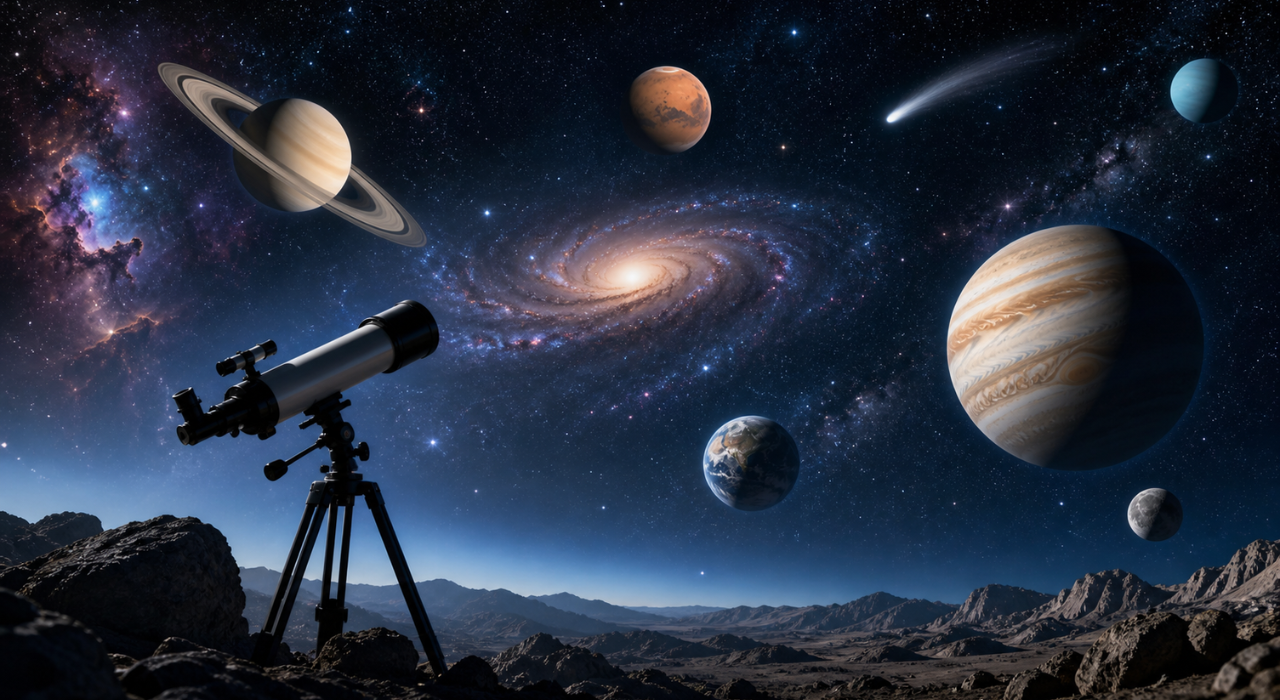
Astronomy 101 is the perfect starting point for anyone curious about the universe, stars, planets, galaxies, and everything beyond Earth. From ancient civilizations observing the night sky to modern telescopes capturing deep-space images, astronomy has always fascinated humanity.
Today, astronomy is not just about looking at stars—it’s a powerful science that helps us understand the origin of the universe, the behavior of celestial objects, and even the possibility of life beyond Earth.
In this guide, we’ll break down the basics of astronomy 101 in a simple, beginner-friendly way so you can build a strong foundation in this exciting field.
What is Astronomy?
Astronomy is the scientific study of space and everything in it, including stars, planets, moons, comets, galaxies, and cosmic phenomena.
Unlike astrology (which is based on beliefs), astronomy is purely scientific and relies on observation, mathematics, and physics.
Main Areas of Astronomy
Astronomy is divided into several branches:
- Observational Astronomy – Studying celestial objects using telescopes and instruments
- Theoretical Astronomy – Using mathematical models to explain cosmic events
- Planetary Astronomy – Focused on planets, moons, and planetary systems
- Cosmology – Study of the origin and evolution of the universe
- Astrophysics – Understanding physical laws behind space phenomena
The Basics of Astronomy 101
If you are starting with Astronomy 101, here are the fundamental concepts you need to understand:
1. The Universe
The universe is everything that exists—space, time, matter, and energy. It contains billions of galaxies, each with billions of stars.
2. Galaxies
A galaxy is a huge system of stars, gas, dust, and dark matter held together by gravity. Our galaxy is called the Milky Way.
3. Stars
Stars are massive glowing spheres of hot gas. The closest star to Earth is the Sun.
4. Planets
Planets are celestial bodies that orbit stars. Our solar system has eight planets.
5. Moons
Moons orbit planets. Earth has one natural satellite—our Moon.
6. Gravity
Gravity is the force that attracts objects toward each other. It keeps planets in orbit around the Sun.
Our Solar System Overview
The solar system is one of the most important topics in astronomy 101. It consists of the Sun and all objects that orbit it.
Planets in Order from the Sun
| Order | Planet | Type | Key Feature |
|---|---|---|---|
| 1 | Mercury | Rocky planet | Closest to the Sun |
| 2 | Venus | Rocky planet | Hottest planet |
| 3 | Earth | Rocky planet | Supports life |
| 4 | Mars | Rocky planet | Known as the Red Planet |
| 5 | Jupiter | Gas giant | Largest planet |
| 6 | Saturn | Gas giant | Famous for rings |
| 7 | Uranus | Ice giant | Rotates on its side |
| 8 | Neptune | Ice giant | Farthest planet |
Tools Used in Astronomy
Astronomers use advanced tools to study space more accurately.
Key Instruments
- Telescopes – To observe distant objects
- Space probes – Robots sent into space
- Satellites – Orbit Earth for data collection
- Radio telescopes – Detect radio waves from space
- Space observatories – Like Hubble Space Telescope
How Astronomers Study Space
Astronomy is not just about looking at the sky. Scientists use advanced methods:
Observation Techniques
- Optical observation (visible light)
- Infrared imaging (heat detection)
- X-ray astronomy (high-energy events)
- Radio astronomy (signals from deep space)
Mathematical Modeling
Astronomers use physics and equations to predict:
- Planet movements
- Star life cycles
- Black hole behavior
- Cosmic expansion
Important Concepts in Astronomy 101
Light-Year
A light-year is the distance light travels in one year. It is used to measure space distances.
Black Holes
Black holes are regions in space where gravity is extremely strong.
Nebulae
Nebulae are clouds of gas and dust where stars are born.
Supernova
A supernova is a powerful explosion of a dying star.
Dark Matter
Invisible matter that does not emit light but affects galaxies.
Why Astronomy is Important
Astronomy helps us understand more than just space. It answers big questions about existence.
Benefits of Studying Astronomy
- Understanding the origin of the universe
- Learning about Earth’s place in space
- Advancing technology (GPS, satellites)
- Inspiring innovation and science education
- Exploring the possibility of extraterrestrial life
Famous Space Missions
Humanity has launched many missions to explore space:
- Apollo Moon missions
- Mars Rover missions (Curiosity, Perseverance)
- Voyager 1 & 2 (deep space exploration)
- Hubble Space Telescope
- James Webb Space Telescope
These missions have changed how we understand the universe.
Astronomy 101 for Beginners: How to Start
If you are new to astronomy, here’s how you can begin:
Step-by-Step Guide
- Start by observing the night sky
- Learn major constellations
- Use free astronomy apps
- Read beginner astronomy books
- Watch documentaries on space
- Join astronomy communities online
Useful Tips
- Start with naked-eye observation
- Learn one topic at a time
- Be consistent with sky watching
- Use simple telescopes first
Common Misconceptions in Astronomy
Many beginners misunderstand space science. Here are some clarifications:
- Stars do not actually “twinkle”—it’s atmospheric interference
- The Sun is a star, not a planet
- Space is not completely empty
- Black holes are not “vacuum cleaners” of space
- The Moon does not produce its own light
FAQs about Astronomy 101
1. What is astronomy 101?
Astronomy 101 is a beginner-level introduction to the study of space, including stars, planets, galaxies, and cosmic phenomena.
2. Do I need math to learn astronomy?
Basic astronomy can be learned without advanced math, but higher-level studies require physics and mathematics.
3. What is the easiest way to start astronomy?
Start by observing the night sky, learning constellations, and using beginner-friendly astronomy apps.
4. Is astronomy hard to learn?
It may seem complex at first, but with step-by-step learning, it becomes easy and enjoyable.
5. What tools do beginners need?
A basic telescope, binoculars, star maps, and astronomy apps are enough to begin.
6. Can astronomy be a hobby?
Yes, astronomy is a popular hobby that can be enjoyed by anyone with curiosity about space.
Final Thoughts
Astronomy 101 opens the door to one of the most fascinating sciences in the world. It helps us explore the universe, understand cosmic mysteries, and appreciate our place in the vast expanse of space.
Whether you’re learning it as a hobby or planning a future in science, astronomy offers endless discovery. The more you explore, the more questions you’ll find—and that’s what makes it truly exciting.
Also Read: Breakfast Nook: Complete Guide to Designing a Cozy and Functional Dining Corner
1 Comment
Comments are closed.