
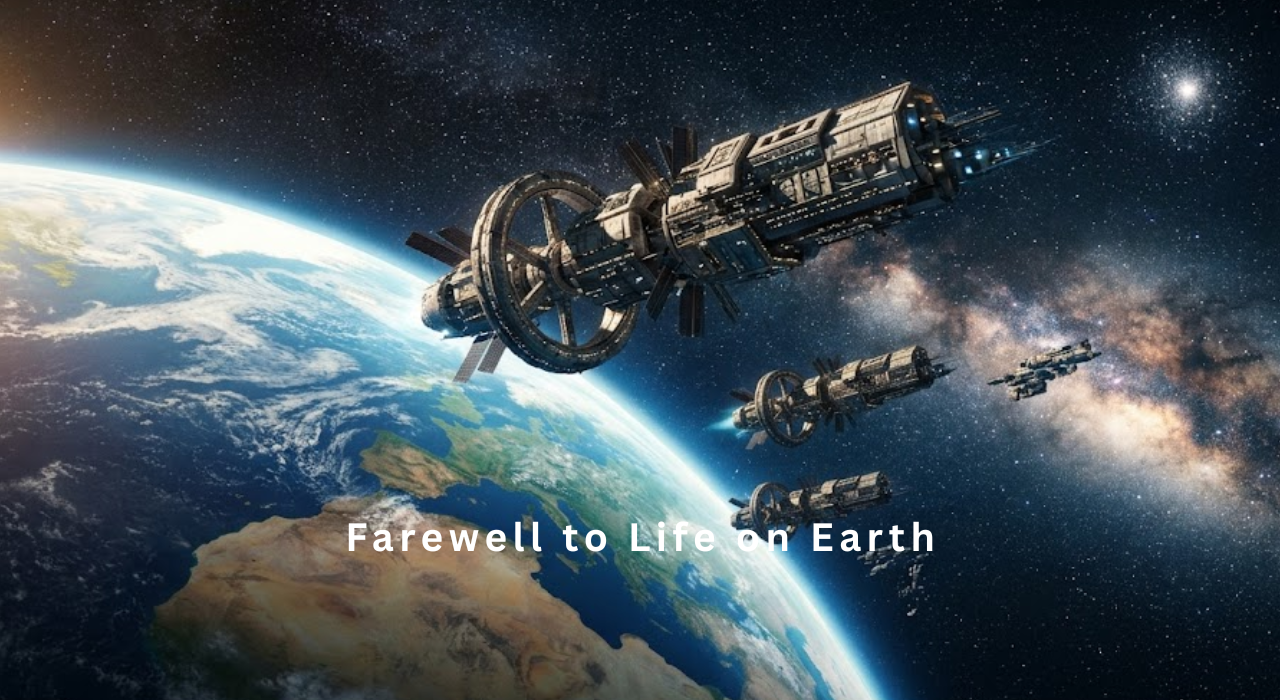
The concept of a “farewell to life on Earth” sounds like the plot of a high-budget sci-fi blockbuster. However, for scientists, futurists, and philosophers, it is a serious topic of discussion. Whether we are talking about the distant death of our sun, the potential for space colonization, or the digital preservation of human consciousness, the idea of leaving our home planet is becoming less of a fantasy and more of a roadmap. “Farewell to Life on Earth“
In this article, we explore the different dimensions of what a farewell to Earth might look like—and why humanity is already preparing for the ultimate departure.
Why Humanity is Looking Beyond Earth
Earth has been our cradle for hundreds of thousands of years, providing the perfect conditions for life to flourish. But the universe is a dynamic and often violent place. There are several driving forces behind the push to look for a second home.
1. Resource Depletion and Sustainability
As our global population grows, the demand for energy, minerals, and fresh water increases. While sustainable practices are helping, some experts argue that the Earth’s carrying capacity has a hard limit. Space mining—harvesting asteroids for rare metals—could be the first step in moving our industrial footprint off-planet.
2. The Threat of Cosmic Events
From asteroid impacts to massive solar flares, the Earth exists in a cosmic shooting gallery. History shows us that extinction-level events are not a matter of “if,” but “when.” Establishing a multi-planetary presence is essentially an “insurance policy” for the human race.
3. The Natural Lifecycle of the Sun
In the very long term—roughly 5 billion years from now—the Sun will expand into a Red Giant, consuming the inner planets. While this is far in the future, it represents the absolute deadline for life on Earth.
Potential Destinations: Where Could We Go?
If we were to say our final farewell to Earth today, where would we head? The options are currently limited, but technology is advancing rapidly.
Mars: The Red Frontier
Mars is the most realistic candidate for near-term colonization. It has a day-night cycle similar to Earth, frozen water at its poles, and an atmosphere that could potentially be thickened through terraforming.
The Jovian and Saturnian Moons
Moons like Europa (Jupiter) and Enceladus (Saturn) are incredibly exciting because they likely harbor subsurface liquid oceans. While the radiation and distance are massive hurdles, these icy worlds could provide the water and energy needed for long-term survival.
O’Neill Cylinders and Space Habitats
We might not need a planet at all. Physicist Gerard O’Neill proposed giant rotating space stations that simulate gravity. These self-sustained ecosystems could house millions of people in Earth-like conditions without the need for a planetary surface.
The Logistics of Departure
Moving a civilization is a massive undertaking. Below is a comparison of the primary methods currently being researched to facilitate a farewell to life on Earth.
| Method | Estimated Timeline | Main Challenge | Primary Goal |
|---|---|---|---|
| Mars Colonization | 20-50 Years | Atmosphere & Radiation | Multi-planetary backup |
| Lunar Base | 10-15 Years | Lack of atmosphere | Research & Launchpad |
| Generation Ships | 200+ Years | Biological aging | Interstellar travel |
| Digital Uploading | Unknown | Consciousness mapping | Post-biological existence |
The Emotional and Philosophical Impact
Saying farewell to life on Earth isn’t just a technical challenge; it’s a psychological one. Earth is the only place we have ever known. Our cultures, religions, and identities are deeply tied to the landscapes of this planet.
- The Overview Effect: Astronauts often describe a profound shift in perspective when looking back at Earth from space. They see a fragile, borderless marble.
- Cultural Preservation: How do we take “Earth” with us? We would need to preserve our music, art, and history in digital vaults to ensure that future generations born on Mars or in deep space understand their heritage.
- A New Human Identity: Those born away from Earth would eventually evolve—both culturally and perhaps physically (due to lower gravity)—into a new branch of humanity.
Technological Breakthroughs Needed
To successfully transition away from Earth, we need to master several key technologies:
- Propulsion Systems: Chemical rockets are too slow for deep space. We are looking into Nuclear Thermal Propulsion and Ion drives to shorten travel times.
- Closed-Loop Life Support: We must create systems that recycle 100% of water, oxygen, and waste.
- Synthetic Biology: Engineering plants that can grow in Martian soil or survive in high-radiation environments will be crucial for food security.
Frequently Asked Questions (FAQs)
1. Is a farewell to life on Earth inevitable?
In the extreme long term, yes. Eventually, the Sun’s evolution will make Earth uninhabitable. However, on a shorter timescale, humanity may choose to leave to explore, mine resources, or ensure species survival.
2. Will everyone be able to leave Earth?
Initially, space travel will likely be reserved for highly trained professionals and the very wealthy. However, the long-term goal of space advocates like SpaceX and Blue Origin is to make space travel as accessible as a transcontinental flight.
3. Can we terraform another planet to look like Earth?
Terraforming Mars is a popular theory. It involves releasing greenhouse gases to warm the planet and create a thicker atmosphere. While theoretically possible, it would likely take hundreds or even thousands of years to complete.
4. What is a “Generation Ship”?
A generation ship is a theoretical spacecraft designed to travel between stars. Because the journey would take centuries, the original crew would grow old and die, and their descendants would continue the mission, eventually arriving at the destination many generations later.
5. How would a move from Earth affect our health?
Low gravity causes muscle atrophy and bone density loss. Future space dwellers would need rigorous exercise programs or artificial gravity (created by rotating the ship or habitat) to maintain their physical health.
Final Thoughts
The idea of saying a “farewell to life on Earth” is bittersweet. It represents the end of an era but also the ultimate coming-of-age for our species. As we look toward the stars, we aren’t just looking for a way to escape; we are looking for a way to grow.
Earth will always be our home, but the universe is our future. By developing the technology to live beyond our atmosphere, we ensure that the story of humanity continues, no matter what happens to our pale blue dot. Whether through physical colonization or digital legacy, the transition to life beyond Earth is the next great frontier in the human narrative.
Also Read: The Flying Elephant Memoirs of an Olympic Champion Kindle Edition Alexander Savin
1 Comment
Comments are closed.