
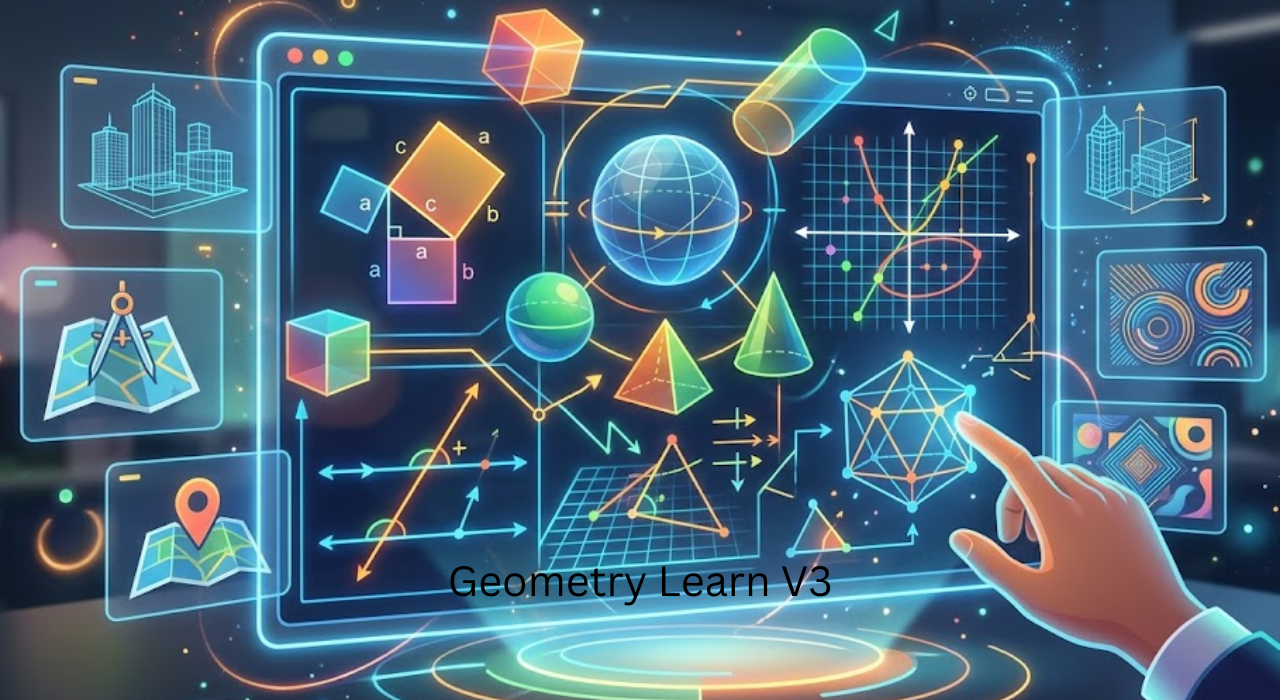
Geometry is often the point where students either fall in love with mathematics or feel completely lost. Traditional textbooks can make spatial concepts feel flat and uninspiring. Enter Geometry Learn V3, a modern approach to mastering shapes, logic, and spatial reasoning through interactive and progressive learning.
Whether you are a student looking to ace your next exam or a lifelong learner wanting to sharpen your mind, understanding how to navigate this third iteration of geometry learning is crucial. This guide breaks down everything you need to know about mastering the subject with clarity and ease.
What is Geometry Learn V3?
Geometry Learn V3 represents the evolution of digital mathematics education. Unlike older versions that focused heavily on rote memorization of theorems, V3 emphasizes visual intuition and interactive application. It bridges the gap between abstract formulas and real-world visualization.
The “V3” philosophy centers on three core pillars:
- Visualization: Seeing the math in 3D space.
- Verification: Real-time feedback on proofs and constructions.
- Versatility: Applying geometric logic to physics, art, and engineering.
Core Concepts You’ll Master
To truly excel in Geometry Learn V3, you must move beyond just knowing the names of shapes. You need to understand how they interact in a coordinate system.
1. Euclidean Fundamentals
Before diving into complex structures, V3 ensures a rock-solid foundation in points, lines, and planes. You will explore how Euclid’s postulates form the “rules of the game” for the entire universe.
2. The Power of Transformations
One of the most engaging parts of the V3 curriculum is the focus on transformations. Instead of static shapes, you learn how objects move through:
- Translations: Sliding a shape across a plane.
- Rotations: Turning a shape around a fixed point.
- Reflections: Flipping a shape over an axis.
- Dilations: Resizing shapes while maintaining proportionality.
3. Trigonometric Integration
Geometry Learn V3 doesn’t treat trigonometry as a separate subject. It weaves sine, cosine, and tangent directly into the study of right triangles, helping you understand the relationship between angles and side lengths as a single cohesive unit.
Essential Formulas at a Glance
Navigating geometry requires a quick reference for the math that powers the logic. Below is a table of the most common formulas utilized in the V3 framework.
Common Geometric Formulas
| Shape | Property | Formula |
| Circle | Area | $A = \pi r^2$ |
| Circle | Circumference | $C = 2\pi r$ |
| Triangle | Area | $A = \frac{1}{2}bh$ |
| Trapezoid | Area | $A = \frac{a+b}{2}h$ |
| Sphere | Volume | $V = \frac{4}{3}\pi r^3$ |
| Cylinder | Volume | $V = \pi r^2 h$ |
How to Study Geometry Effectively
Many people struggle with geometry because they try to study it like a history book. You cannot simply read geometry; you must do geometry. Here are the best strategies for success:
Draw Everything
Your brain processes spatial information differently than text. Whenever you encounter a word problem, draw the diagram immediately. Label every known angle and side length. This simple act often reveals the “hidden” path to the solution.
Master the “Why,” Not Just the “What”
In Geometry Learn V3, understanding the proof is more important than the final answer. If you know why the Pythagorean Theorem works ($a^2 + b^2 = c^2$), you won’t need to panic if you forget the formula during a test—you’ll be able to derive the logic yourself.
Use Interactive Tools
Take advantage of software like GeoGebra or Desmos. These tools allow you to manipulate shapes in real-time. Seeing a triangle’s interior angles always sum to 180 degrees—no matter how much you stretch the vertices—is a powerful “aha!” moment that sticks with you longer than a lecture.
The Role of Logic and Proofs
Proofs are the heartbeat of geometry. In the V3 era, the focus has shifted toward flowchart proofs and paragraph proofs, moving away from the rigid two-column format that many find intimidating.
- Deductive Reasoning: Starting with a general rule to reach a specific conclusion.
- Inductive Reasoning: Looking for patterns to create a hypothesis.
- Counterexamples: Finding a single instance where a statement is false to disprove a theory.
Learning these logical structures doesn’t just help with math; it improves your ability to argue effectively and think critically in everyday life.
Real-World Applications of Geometry
Why does learning this matter? Geometry is the language of the physical world.
- Architecture & Construction: From the pitch of a roof to the structural integrity of a bridge, geometry ensures our buildings are safe and beautiful.
- Graphic Design: Modern UI/UX design relies on geometric grids, golden ratios, and typography spacing.
- Navigation: Pilots and sailors use spherical geometry to plot courses across the globe.
- Medical Imaging: MRI and CT scans use geometric algorithms to turn data into 3D models of the human body.
Frequently Asked Questions (FAQ)
1. Is Geometry Learn V3 harder than traditional geometry?
Not necessarily. While it covers the same rigorous material, the focus on interactive visuals and conceptual understanding usually makes it more intuitive for modern learners who are used to digital environments.
2. What is the most important topic in geometry?
Triangles are often considered the most important. Most other polygons can be broken down into triangles, and the relationship between their sides and angles (Trigonometry) is used in almost every scientific field.
3. Do I need to be “good at math” to learn geometry?
Geometry uses a different part of the brain than Algebra. Many students who struggle with long equations find that they actually excel in geometry because it is more visual and logic-based.
4. How can I improve my geometric proofs?
Practice identifying “given” information and “definitions.” Most people get stuck because they forget they can use basic definitions (like what an isosceles triangle is) as a bridge to their next logical step.
5. Can I use Geometry Learn V3 for self-study?
Absolutely. Its structure is designed to be modular, meaning you can focus on specific areas like Coordinate Geometry or Volume/Surface Area at your own pace.
Final Thoughts
Mastering Geometry Learn V3 is about more than just passing a class—it’s about developing a new lens through which to see the world. By focusing on visualization, leveraging interactive tools, and mastering the underlying logic of proofs, you turn a potentially frustrating subject into a rewarding puzzle.
The skills you build here—spatial reasoning, critical thinking, and logical deduction—will serve you long after you’ve solved your last equation. Start small, draw often, and embrace the process of discovery that geometry offers.
Also Read: Btwletternews by Betterthisworld website: A Deep Dive into BetterThisWorld’s Vision
1 Comment
Comments are closed.